The Spark of Intelligence
Imagine reading a book. Do you scan every single letter of every word sequentially? No. Your eyes dart around. You skip filler words. You focus intensely on the characters, the plot twists, the relationships.
For decades, AI didn't work like that. It was a grinder. It processed "The", then "cat", then "sat", blindly marching forward, often forgetting "The" by the time it reached "mat". It was processing, but it wasn't understanding.
Then came Attention.
Attention taught machines to stop marching and start looking. It gave AI the ability to say:
"To understand this word, I need to look at that word over there."
This wasn't just an algorithm update. It was the moment AI moved from memorizing sequences to understanding relationships. It is the ghost in the machine of GPT-4, Claude, and every modern AI.
The Sequential Processing Bottleneck
Recurrent Architectures: RNNs and LSTMs
Recurrent Neural Networks process sequences through iterative state updates:
where \(h_t\) is the hidden state at position \(t\), \(x_t\) is the input, and \(f\) is a parameterized function (e.g., tanh or LSTM cell). This creates a sequential dependency chain:
# Sequential dependency in RNNs

h_1 = f(h_0, x_1)  # Must complete before h_2

h_2 = f(h_1, x_2)  # Depends on h_1

h_3 = f(h_2, x_3)  # Depends on h_2

...

h_n = f(h_{n-1}, x_n)  # O(n) sequential steps
Three Fundamental Limitations
1. The "Telephone Game" Problem
Information Decay:
By the time the network reaches the 100th word, the information from the 1st word has been transformed 99 times. Like a game of telephone, the signal degrades with each step, making it nearly impossible to remember precise details from the start.
2. Vanishing Gradient Problem
Gradient Flow: \(\frac{\partial L}{\partial h_1} = \frac{\partial L}{\partial h_n} \prod_{t=2}^{n} \frac{\partial h_t}{\partial h_{t-1}}\)
Backpropagation through \(n\) time steps involves a product of \(n-1\) Jacobian matrices. Even with LSTMs, gradients decay exponentially with distance, making it difficult to learn long-range dependencies.
3. Fixed-Capacity Bottleneck
Information Compression: \(h_t \in \mathbb{R}^d\) (fixed dimension)
All information from positions \(1\) to \(t-1\) must be compressed into a single \(d\)-dimensional vector. This is a lossy compression that discards information, especially problematic for long sequences where \(n \gg d\).
RNNs impose a sequential inductive bias that conflicts with parallel hardware. The recurrent connection \(h_t = f(h_{t-1}, x_t)\) creates a data dependency that prevents parallelization and forces information through a fixed-capacity channel.
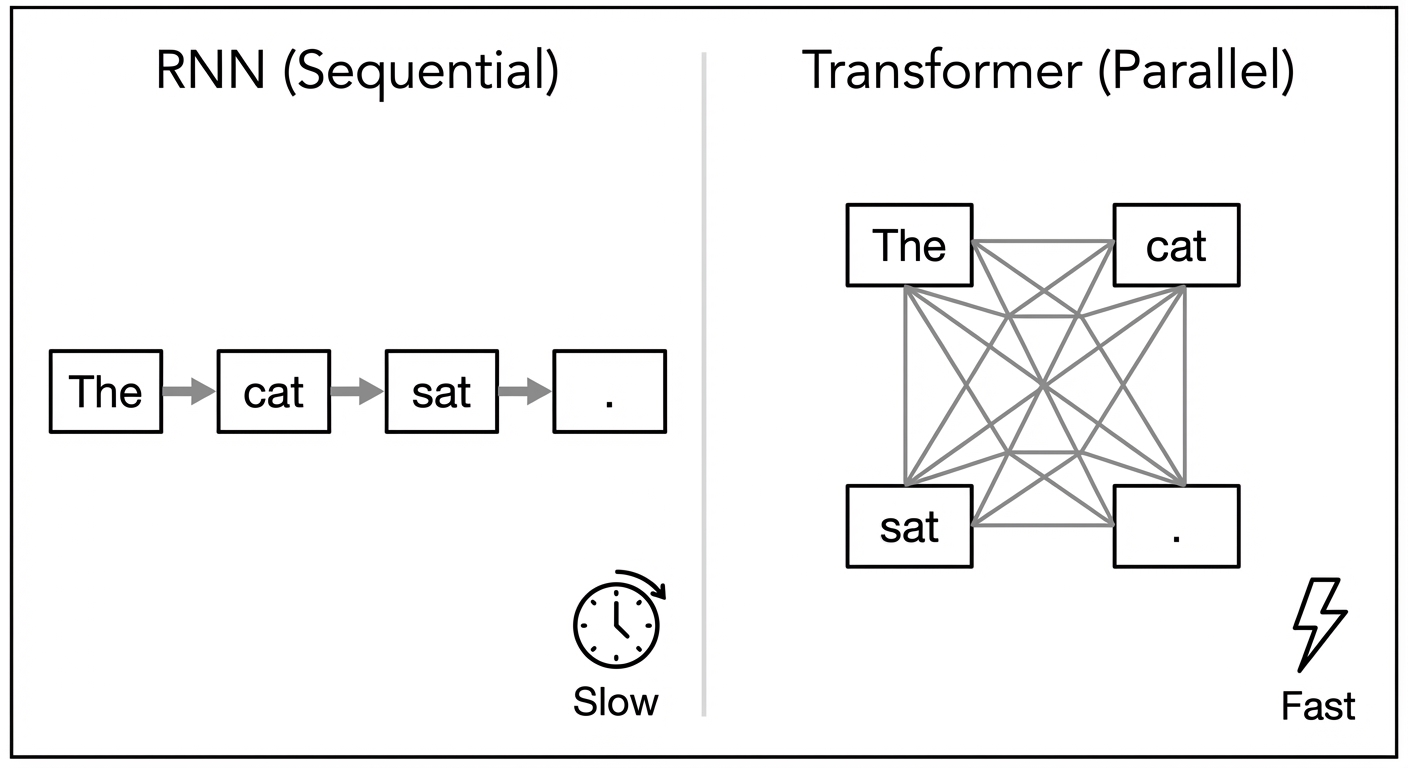
Sequential bottleneck (RNN) vs parallel processing (Transformer)
The Solution: Attention Mechanism
The Big Idea
What if, instead of compressing everything into a hidden state, we could look at all positions simultaneously and compute how much each position should "attend to" every other position?
For each word, compute a weighted sum of all other words, where the weights represent "how much should I pay attention to that word?"
Intuitive Example: Translation
Imagine translating "The cat sat on the mat" to French: "Le chat s'est assis sur le tapis."
When generating the French word "chat" (cat), the model should pay high attention to the English word "cat", but also some attention to "The" (for gender agreement: "Le" vs "La").
Attention Weights Visualization
When generating "chat", which English words should we focus on?
How Attention Works: The Mathematics
The Three Key Components: Query, Key, Value
Attention is built on three learned transformations of the input:
🔍 Query (Q)
"What am I looking for?"
Q = X · W_Q
🔑 Key (K)
"What do I contain?"
K = X · W_K
💎 Value (V)
"What information do I provide?"
V = X · W_V
Imagine you are at a loud cocktail party.
- Query (Q): You are looking for someone to talk about Quantum Physics. You broadcast this interest.
- Key (K): Everyone at the party has a sign on their chest saying what they are an expert in (e.g., "Cooking", "Physics", "Dancing").
- Value (V): The actual conversation/knowledge they can share with you.
The Process:
1. You compare your Query ("Quantum Physics") with everyone's
Key.
2. You find a high match with the "Physics" person (High Attention Score).
3. You focus 90% of your attention on them and ignore the "Cooking" person.
4. You absorb their Value (the knowledge).
The Philosophy of Meaning
This mechanism implies something profound about language: Meaning is not static.
In a dictionary, the word "Bank" has a fixed definition. But in the human mind (and in Attention), the word "Bank" is an empty vessel until it interacts with its context.
The word "Bank" in "River Bank" is fundamentally a different mathematical object than "Bank" in "Bank Deposit". Attention allows the word to change its own identity based on who it is standing next to.
The Attention Formula: Deconstructed
The formula is just the mathematical version of the cocktail party:
Where \(d_k\) is the dimension of the key vectors
Breaking It Down Step-by-Step
\( \text{Scores} = QK^T \)
Dot product between query and all keys. High score = high relevance.
\( \text{Scaled} = \frac{QK^T}{\sqrt{d_k}} \)
Divide by √d_k to prevent extremely large values that would make softmax saturate.
\( \text{Weights} = \text{softmax}\left(\frac{QK^T}{\sqrt{d_k}}\right) \)
Softmax converts scores to a probability distribution (all weights sum to 1).
\( \text{Output} = \text{Weights} \cdot V \)
Multiply attention weights by values and sum. High-attention positions contribute more.
Each output is a context-aware representation. The word "bank" will have different representations in "river bank" vs "savings bank" because it attends to different surrounding words.
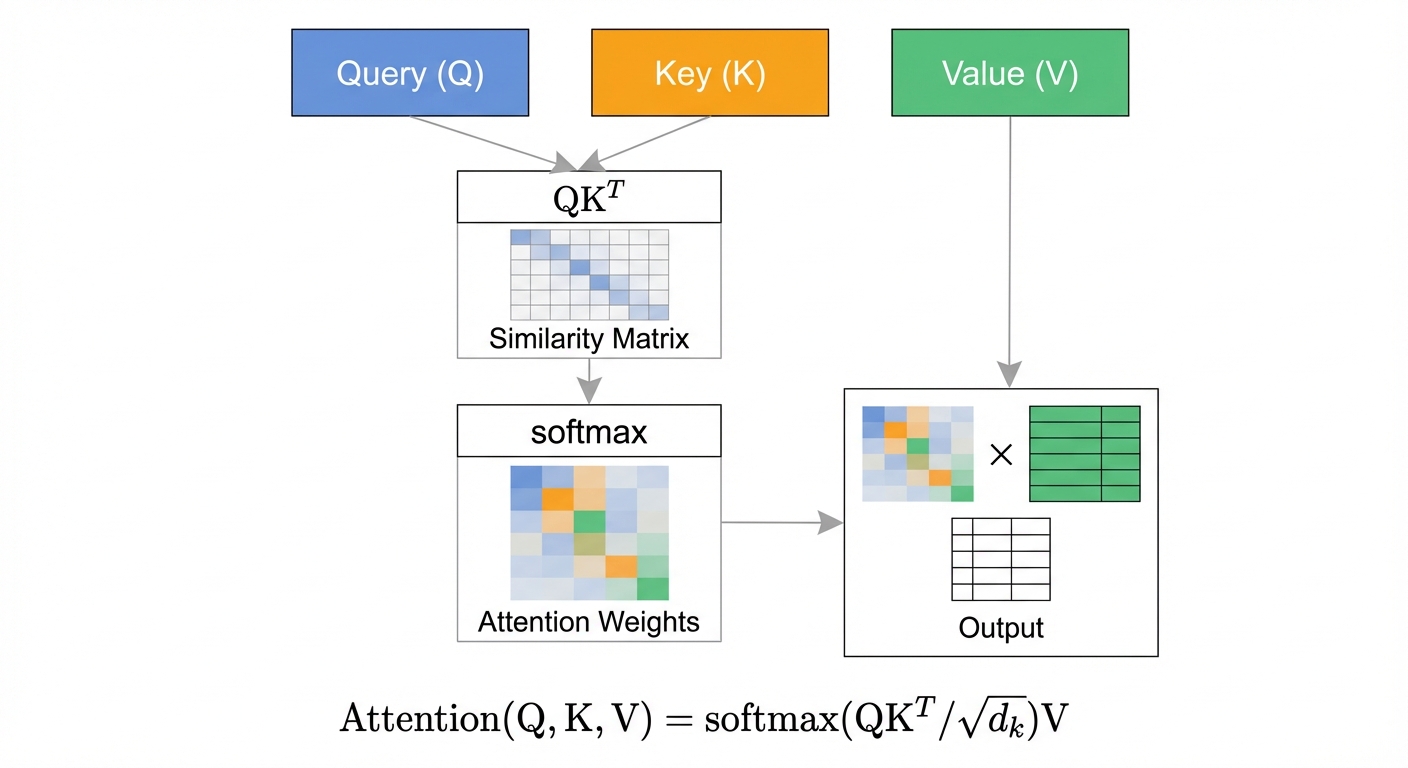
The complete attention mechanism: from Q, K, V to context-aware output
Concrete Example: Computing Attention
Let's walk through a real example with the sentence: "The cat sat"
Step 1: Create Q, K, V Matrices
# Input embeddings (simplified to 4 dimensions)

X = [

  [0.1, 0.2, 0.3, 0.4],  # "The"

  [0.5, 0.6, 0.7, 0.8],  # "cat"

  [0.9, 1.0, 1.1, 1.2]   # "sat"

]


# Learned weight matrices (simplified)

Q = X @ W_Q  # Query matrix

K = X @ W_K  # Key matrix

V = X @ W_V  # Value matrix
Step 2: Compute Attention Scores
# Compute similarity between all query-key pairs

scores = Q @ K.T  # Shape: [3, 3]


# Example output (how much each word attends to others):

scores = [

  [0.8, 0.3, 0.1],  # "The" attends to: The(high), cat(low), sat(low)

  [0.2, 0.9, 0.5],  # "cat" attends to: The(low), cat(high), sat(med)

  [0.1, 0.4, 0.7]   # "sat" attends to: The(low), cat(med), sat(high)

]
Step 3: Apply Softmax
# Scale and normalize to probabilities

attention_weights = softmax(scores / sqrt(d_k))


# Each row now sums to 1.0

attention_weights = [

  [0.60, 0.25, 0.15],  # "The" distribution

  [0.15, 0.65, 0.20],  # "cat" distribution

  [0.10, 0.30, 0.60]   # "sat" distribution

]
Step 4: Weighted Sum of Values
# Final output: context-aware representations

output = attention_weights @ V


# Each word now has information from relevant context

# "cat" output = 0.15*V_The + 0.65*V_cat + 0.20*V_sat
Notice that "cat" pays most attention to itself (0.65), but also incorporates information from "sat" (0.20) and "The" (0.15). This creates a context-aware representation that's different from the original embedding.
Multi-Head Attention: Multiple Perspectives
Single attention is powerful, but multi-head attention is even better. Instead of one attention mechanism, we run multiple in parallel, each learning different relationships.
Imagine reading a sentence through different lenses:
- Head 1: Focuses on syntactic relationships (subject-verb agreement)
- Head 2: Focuses on semantic meaning (word associations)
- Head 3: Focuses on positional relationships (nearby words)
- Head 4: Focuses on long-range dependencies
The Formula
Where each head_i = Attention(QW_i^Q, KW_i^K, VW_i^V)
# Pseudocode for Multi-Head Attention


def multi_head_attention(X, num_heads=8):

    heads = []


    for i in range(num_heads):

        # Each head has its own Q, K, V projections

        Q_i = X @ W_Q[i]

        K_i = X @ W_K[i]

        V_i = X @ W_V[i]


        # Compute attention for this head

        head_i = attention(Q_i, K_i, V_i)

        heads.append(head_i)


    # Concatenate all heads and project

    output = concat(heads) @ W_O

    return output
Different heads can specialize in different types of relationships. One head might learn to connect pronouns to their antecedents, another might learn syntactic structure, and another might capture semantic similarity. The model learns what each head should focus on during training.
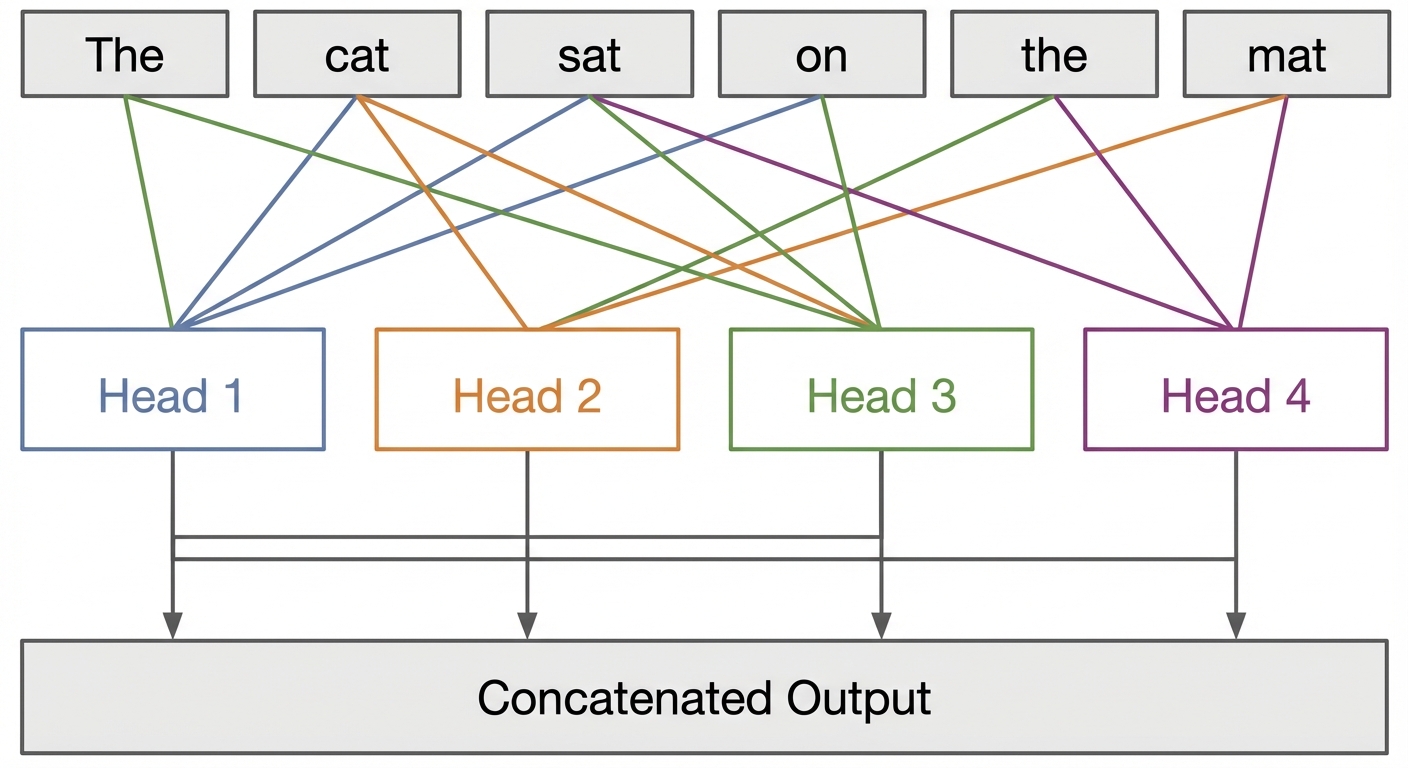
Multiple attention heads learning different types of relationships in parallel
Self-Attention vs Cross-Attention
🔄 Self-Attention
Q, K, V all come from the same sequence
Used in: GPT, BERT encoder
Purpose: Each word attends to other words in the same sentence
Q = K = V = X

# "The cat sat" attends to itself
🔀 Cross-Attention
Q from one sequence, K and V from another
Used in: Encoder-Decoder models (translation)
Purpose: Target language attends to source language
Q = decoder_output

K = V = encoder_output

# French attends to English
Attention in the Transformer
The "Attention Is All You Need" paper (2017) showed that you could build an entire architecture using only attention mechanisms—no RNNs, no convolutions. This architecture is called the Transformer.
Stack multiple layers of multi-head self-attention, each followed by feed-forward networks and residual connections. That's it. No sequential processing needed.
The Transformer uses attention in three key ways:
- Self-Attention in Encoder: Each word attends to all other words in the input sequence
- Self-Attention in Decoder: Each generated word attends to previously generated words
- Cross-Attention: Decoder attends to encoder output (e.g., French attends to English in translation)
Because attention can process all positions in parallel and create direct connections between any two positions, it solves the three fatal flaws of RNNs:
- ✅ Parallelization: All positions processed simultaneously
- ✅ Long-range dependencies: Direct connections, no information loss
- ✅ No fixed bottleneck: Each position gets its own context-aware representation
Note: We'll explore the complete Transformer architecture in detail in a future post. For now, the key takeaway is that attention is the core mechanism that makes it all work.
The Evolution: From Attention to Modern LLMs
2014: Attention for Translation
Bahdanau et al. introduce attention mechanism for neural machine translation. Still uses RNNs, but adds attention to help with long sequences.
2017: Attention Is All You Need
Vaswani et al. remove RNNs entirely. Pure attention-based architecture (Transformer) achieves state-of-the-art on translation.
2018: BERT & GPT
BERT (bidirectional) and GPT (autoregressive) show Transformers work for general language understanding, not just translation.
2020: GPT-3
175 billion parameters. Shows that scaling Transformers leads to emergent abilities like few-shot learning and reasoning.
2022-2024: ChatGPT, GPT-4, LLaMA
Transformers become the foundation of conversational AI. Attention mechanism is now the backbone of every major LLM.
How Attention Should Change Your Mental Model of LLMs
❌ Old Mental Model (Wrong)
"LLMs are just fancy autocomplete that predict the next word."
This misses the fundamental mechanism. It's not about memorizing sequences—it's about learning relationships.
✅ New Mental Model (Correct)
"LLMs are relationship engines that learn which concepts should attend to which other concepts."
Every layer learns increasingly abstract relationships. Early layers learn syntax, middle layers learn semantics, deep layers learn reasoning patterns.
Key Insights to Internalize
The meaning of "bank" isn't fixed—it's computed by attending to surrounding words. Every token's representation is context-dependent.
The model learns what to attend to through training. You don't tell it "pronouns should attend to nouns"—it discovers this pattern from data.
Layer 1 might learn "this word follows that word." Layer 10 might learn "this argument supports that conclusion." Each layer refines understanding.
Because attention is parallel, we can train on massive datasets with massive models. This is why GPT-4 has 1.7 trillion parameters—attention makes it tractable.
Unlike black-box neural nets, you can visualize attention patterns. This helps debug, improve, and understand model behavior.
A Linguistic Perspective: Why Attention Feels "Human"
If we look at attention through the lens of linguistics, we can see it's not just a mathematical trick—it's rediscovering fundamental structures of language.
1. Anaphora Resolution
"The robot picked up the ball because it was programmed to."
Attention connects the pronoun "it" back to "The robot". This is exactly what we do when we read. The model learns that "it" needs to attend to the subject of the sentence.
2. Word Sense Disambiguation
"I went to the bank to deposit money."
The word "bank" attends strongly to "deposit" and "money". This context pulls the representation of "bank" towards the financial meaning, distinguishing it from a river bank.
3. Syntactic Dependencies
"The cat, which was black and fluffy, sat on the mat."
The verb "sat" needs to know who sat. Attention allows it to skip over the entire descriptive clause ("which was black and fluffy") and attend directly to the subject "cat".
This mimics human cognitive processing. When you read a complex sentence, you don't hold every word in your working memory with equal weight. You focus (attend) on the relevant parts to construct meaning. Attention gives neural networks this same ability to focus.
Conclusion: The Algorithm of Understanding
We started by asking how machines can understand language. The answer turned out to be surprisingly human: by paying attention.
Attention is more than just a mechanism for routing information. It is a statement about the nature of intelligence itself. Intelligence is not just processing data; it is the ability to discern relevance. It is the ability to look at a chaotic world and say, "This matters, and that doesn't."
When you look at a Transformer model, you aren't just seeing matrix multiplications. You are seeing a machine that is learning to see the world the way we do: as a web of interconnected relationships, where nothing exists in isolation, and everything is defined by what it pays attention to.
The paper said "Attention Is All You Need." Perhaps they were right in a deeper way than they realized. To understand is to attend.